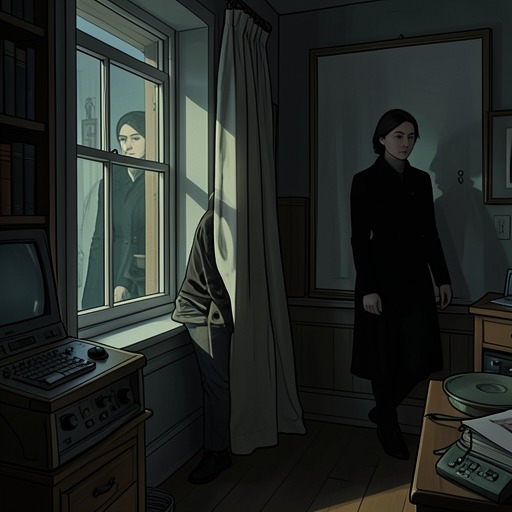
“the tapestry was the world”
The Crying of Lot 49“the tapestry was the world” names the revelation at the center of Oedipa Maas’s encounter with Remedios Varo’s painting. Frail girls imprisoned in a circular tower weave a tapestry that contains the earth; for Oedipa, the image collapses the distinction between the world outside her confinement and the confinement itself, making escape newly uncertain.
The Painting and Its Image
In Mexico City, Oedipa and Pierce Inverarity encounter a painting in the central panel of a triptych titled “Bordando el Manto Terrestre.” It shows girls with heart-shaped faces, huge eyes, and spun-gold hair, held in the upper room of a circular tower. They embroider a tapestry that spills through the windows into a void. The work’s startling proposition is that the tapestry contains the earth’s buildings, creatures, waves, ships, and forests: the world is not beyond the woven fabric but constituted by it.
The image turns an act of making into a model of enclosure. The girls attempt to fill a void, yet everything that might seem to lie beyond their tower is already present in what they weave. The tower, tapestry, and world therefore do not form separate places between which a captive might simply travel; they belong to one enclosing structure.
Oedipa’s Recognition
Oedipa stands before the painting and cries, unnoticed behind dark green bubble shades. She imagines the tears filling the space inside the lenses, preserving the sadness and refracting the world through those particular tears. The moment makes her response intensely personal rather than merely an aesthetic reaction: she recognizes her own imagined captivity in the painted girls.
She had pictured herself as a pensive maiden imprisoned among the pines and salt fogs of Kinneret, waiting for a rescuer. Pierce had seemed to answer that fantasy, but the memory of their affair does not provide a route out. Looking at the painting, Oedipa realizes that the ground beneath her feet was, figuratively, woven in her own tower; Mexico was only an accidental name for where she stood. Pierce had taken her away from nothing, because the imagined outside was not an escape from the structure that held her.
The Tower and the Limits of Escape
The phrase’s force comes from reversing the familiar rescue story. Oedipa’s tower had seemed to be a particular place, and Pierce the knight who could carry her elsewhere. The painting makes the tower’s location and architecture incidental: what keeps the captive in place is an anonymous, malignant magic arriving from outside, not simply the walls around her. If the tower is everywhere, a rescuer who can leave it offers no proof against its power.
Oedipa has no instrument for examining this formless force beyond fear and ingenuity. The passage imagines the possible responses as superstition, embroidery, madness, or marriage to a disc jockey. These alternatives leave the source of confinement unresolved. The tapestry image thus does not disclose a practical escape; it gives Oedipa a way to see why changing location, even with Pierce, may not change the conditions that shape her experience.
Narrative Significance
The painting concentrates Oedipa’s larger uncertainty into a visual paradox: the world is both the thing she seeks to understand and the fabric of the enclosure from which she seeks release. Its woven world also makes the act of interpretation part of the problem. If the whole is contained within the tapestry, discovering another place or another explanation does not necessarily mean reaching an exterior beyond it.
The phrase is therefore less a settled explanation than a recognition that destabilizes the distinction between inside and outside. Oedipa’s tears mark the emotional cost of that recognition, while the unresolved question of what she wants to escape from keeps the image open. The tapestry offers neither a knight’s deliverance nor a clear account of the force that confines her; it reveals that the world she hoped to leave may already be inseparable from her tower.